

Insurance premiums are paid in advance to insurance and occupational pension companies to provide insurance coverage for an agreed period. This means there is usually a delay between the payment of a premium and the payout of compensation if a claim occurs. For pension and life insurance, there are typically many years between the payment of premiums and payouts in the form of a pension or other savings. In addition to payouts, premiums must cover operating costs, such as premises costs and salaries for the companies’ employees.
For non-life insurance, total premiums amounted to just over SEK 123 billion in 2025, of which nearly SEK 28 billion was paid by businesses and around SEK 95 billion by households. For pension and life insurance, premiums paid amounted to just over SEK 453 billion.
It is common for an individual to have several different types of insurance, such as home insurance, motor vehicle insurance and occupational pension insurance. In 2025, an average of approximately SEK 9,000 in non-life insurance premiums was paid per person in Sweden, along with around SEK 43,000 in pension and life insurance premiums. However, it is not always the individual who pays the premium. Nearly half (48 per cent) of pension and life insurance premiums were paid by employers as occupational pension contributions. Some non-life insurance premiums are also paid by employers, for example for certain accident and health insurance policies.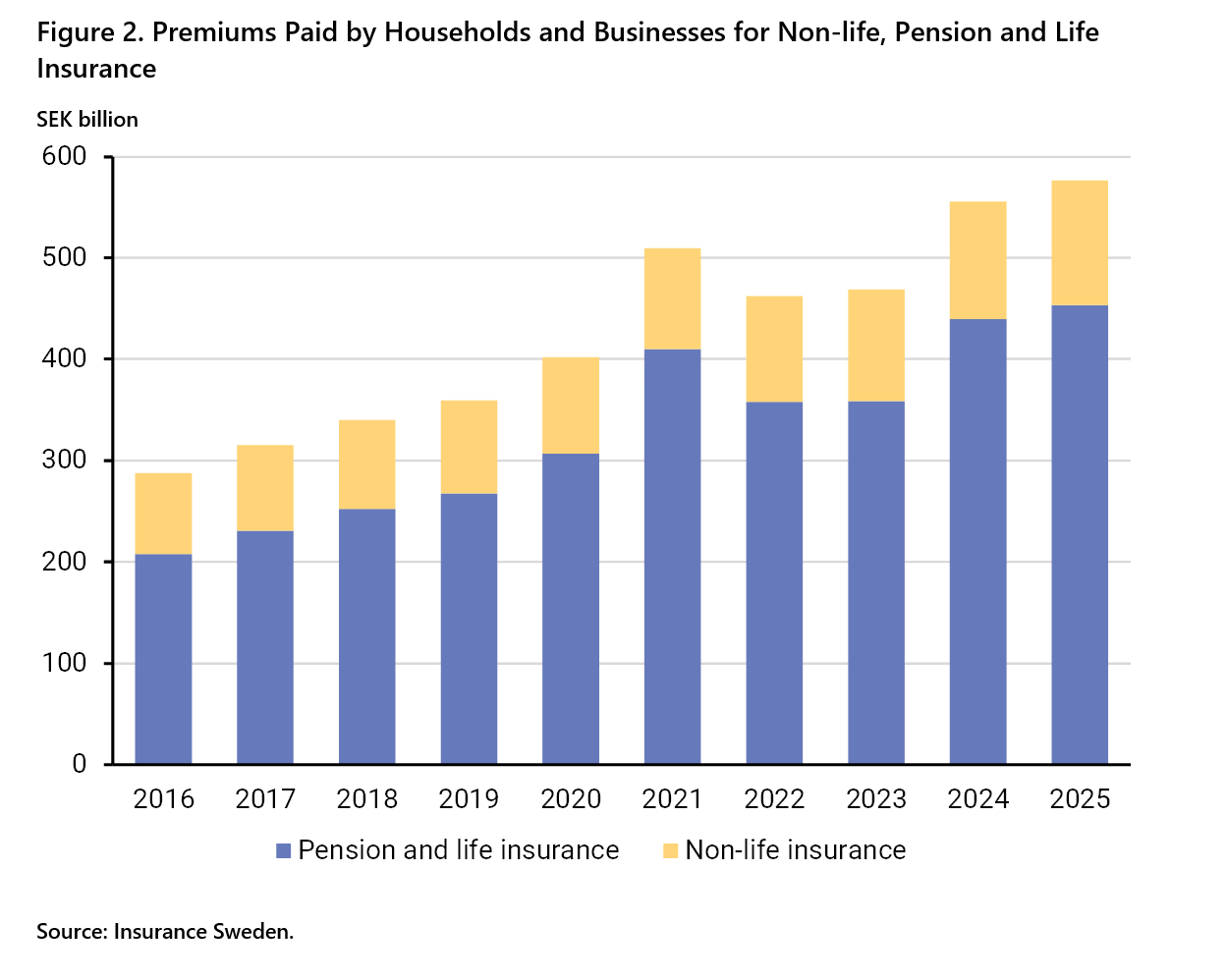
This page is based on our report Insurance in Sweden 2016–2025.
